


Seeing the full customer: how Streambased powers AI-driven support
AI support is only as good as the customer context it can see. This article explains how Streambased brings real-time events and historical data together, giving AI agents the full picture needed to spot churn signals, prioritise high-value customers and make better support decisions.
June 11, 2026

A retail customer contacts support about a refund. The AI handles it as routine – but fails to see they are high-value, and this is their fourth issue in six weeks.
Here’s how Streambased can give agents the full picture...
In any high-volume support environment, such as a retail contact centre, financial services helpdesk or media subscription team, agents work from whatever the screen in front of them shows. Typically that’s a CRM record, a ticket history, maybe a live order status pulled from a separate system.
But the picture is always partial. Agents make judgements based on what’s visible, and what's visible is rarely the full story.
AI support deployments inherit exactly the same problem, often in a more acute form. The model reasons over whatever data it’s been given access to – and, in most current architectures, that means either a historical profile or a real-time event feed, but not both together, and rarely in a form that supports reasoning across the two simultaneously.
Past v present: the flawed choice
A historical profile tells you who the customer is: their purchase history, their account tier, their typical behaviour. A real-time feed shows you what's happening right now: the open order, the payment that just failed, the ticket they raised this morning.
Each is useful but neither on its own is enough. And when you have one without the other, decision-making is always flawed.
In financial services, for example, a customer calling about an unexplained transaction looks entirely different depending on what’s in their history. If their account shows two previous disputed charges in three months and a pattern of high-value activity that has recently dropped, you’re looking at a churn signal requiring every different response than a clean first-contact query.
Without the historical layer, the AI sees only the immediate event. Without the real-time layer, it might be reasoning from a profile that's days out of date.
A retail customer raising a delivery complaint when their account shows three orders in transit and a long history of high satisfaction is a straightforward operational issue. The same complaint from someone with three recent escalations and a loyalty account that’s gone quiet is a relationship risk.
An AI working from half the picture handles both identically.
Media subscription businesses face a version of this on the retention side. A cancellation request from an account with three years’ continuous subscription and three weeks of sharply reduced engagement is not the same signal as a cancellation from a two-month-old account.
The response that retains one will do nothing for the other… but only an AI with access to both the real-time action and the historical relationship can tell them apart.
Bringing real-time + context together
Streambased closes that gap between real-time and historical data without the architectural complexity that usually comes with it.
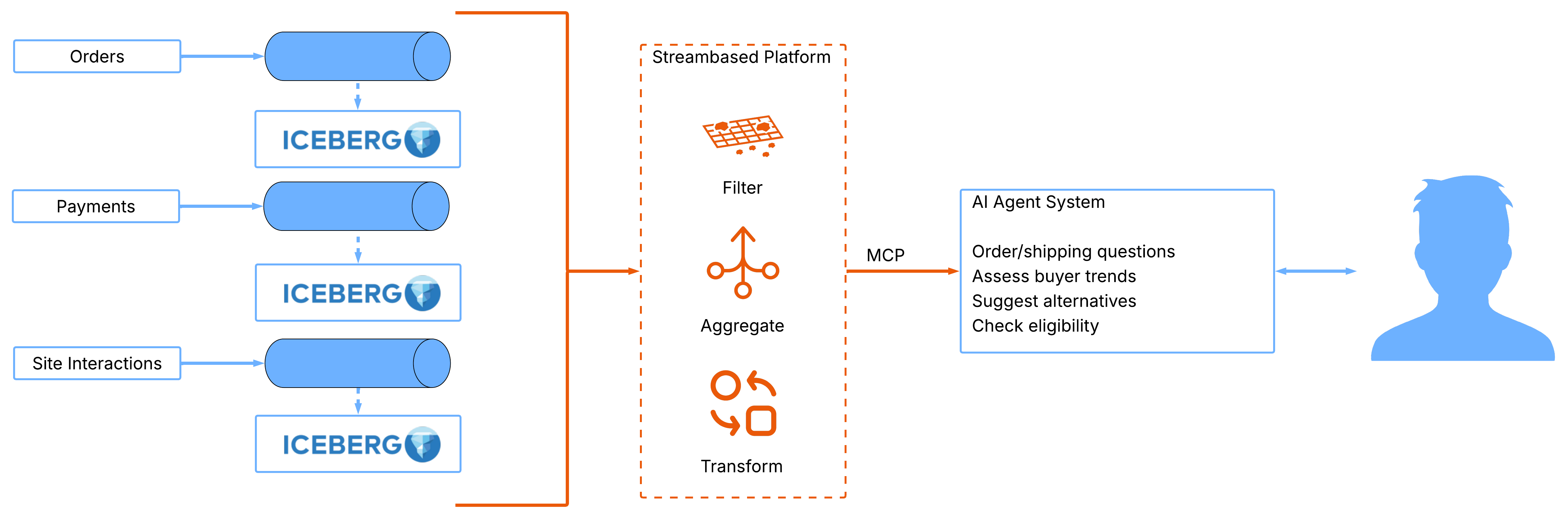
As Kafka streams capture order events, payment updates, ticket changes and browsing activity in real time, those same streams persist to Iceberg, building a scalable historical foundation without a separate ETL process.
Streambased sits across both as a unified query layer, joining live and historical data at the moment the AI agent needs it. The agent retrieves structured, current context via MCP – not a raw data dump, but a precise view of the customer drawn from both what’s happening and what’s happened before.
The operational effect compounds across the customer base. Churn signals surface before they become churn. High-value accounts receive responses that reflect their true relationship with the business rather than just the immediate transaction.
Patterns that would previously only emerge in retrospective analysis become visible in the moment they matter.
Built for regulated industries
There’s a governance dimension that's particularly relevant in regulated sectors. Because Streambased works without copying or moving data, access controls and audit trails remain intact throughout.
The AI agent sees what it’s authorised to see, access is logged, and the lineage of any decision is traceable. In financial services especially, where regulators increasingly want to understand the data behind automated decisions, that’s a significant operational advantage.
In AI support deployments, it is tempting to see the model’s reasoning ability as the limiting factor.
In fact, the real problem is often the data it’s been given to reason with. Streambased changes that.
Our next post in this series looks at real-time personalisation, and why the same principle applies when the stakes are a recommendation rather than a resolution.
If you missed the first article in the series, check out What your AI agents don't know is costing you